
2027 HSA, HDHP, DPCSA, and Excepted Benefit HRA Limits: What Employers Need to Know

IRS Announces 2027 Benefit Limit Updates
The IRS has issued the 2027 inflation-adjusted limits for Health Savings Accounts (HSAs), high deductible health plans (HDHPs), direct primary care service arrangements (DPCSAs), and excepted benefit health reimbursement arrangements (HRAs). These updated amounts apply for calendar year 2027, or for plan years beginning in 2027 where applicable.
Employers offering HSA-compatible HDHPs should use these new figures when reviewing plan design, payroll settings, employee communications, and open enrollment materials for the 2027 plan year.
2027 Benefit Limit Comparison
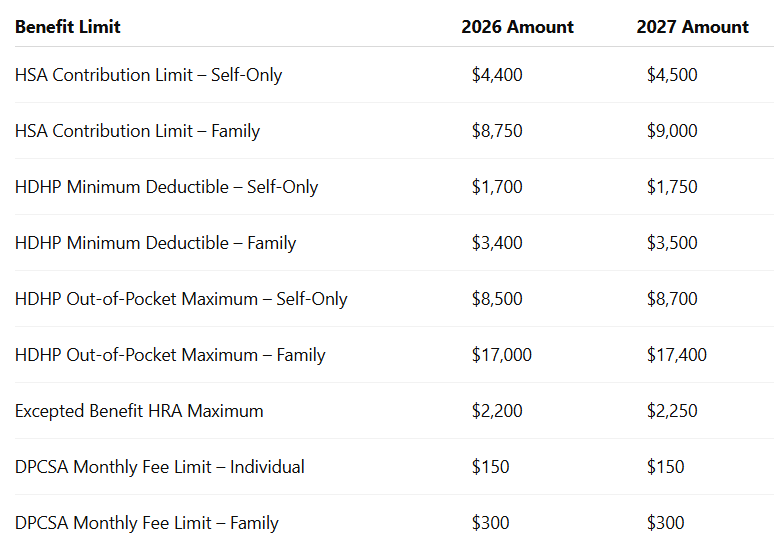
Key Changes for 2027
For 2027, eligible individuals with self-only HDHP coverage may contribute up to $4,500 to an HSA, while individuals with family HDHP coverage may contribute up to $9,000. The minimum deductible for an HSA-compatible HDHP increases to $1,750 for self-only coverage and $3,500 for family coverage.
The maximum out-of-pocket limit for HDHPs also rises in 2027. Self-only HDHP coverage may not exceed $8,700 in annual out-of-pocket expenses, while family coverage may not exceed $17,400.
The excepted benefit HRA limit increases to $2,250 for plan years beginning in 2027. DPCSA monthly fee limits remain unchanged at $150 for individual coverage and $300 for family coverage.
HSA Catch-Up Contributions Remain Unchanged
Individuals who are age 55 or older and enrolled in an HSA-compatible HDHP may continue making an additional $1,000 annual HSA catch-up contribution. This amount is not indexed for inflation and has remained unchanged since 2009.
Employees should also remember that HSA catch-up contributions generally stop once they enroll in Medicare.
ACA Embedded Out-of-Pocket Maximum Considerations
Employers sponsoring non-grandfathered HSA-compatible HDHPs should review family coverage carefully. Under Affordable Care Act cost-sharing rules, family coverage generally must include an embedded individual out-of-pocket maximum for each covered person unless the plan’s aggregate family out-of-pocket maximum does not exceed the ACA individual limit.
For 2027, the ACA individual out-of-pocket maximum is $12,000. Because the 2027 family HDHP out-of-pocket maximum is $17,400, many family HDHP designs will need an embedded individual limit that complies with ACA requirements.
Employers should also ensure that any embedded deductible or out-of-pocket structure does not cause benefits to be paid before the applicable HDHP minimum deductible is satisfied. For 2027 family HDHP coverage, that minimum deductible is $3,500.
DPCSA Limits and HSA Eligibility
Employers that offer direct primary care service arrangements should confirm that DPCSA fees do not exceed the 2027 monthly limits. The monthly cap remains $150 for individual coverage and $300 for family coverage.
For individual coverage, the $150 monthly cap equals $1,800 annually. For family coverage, the $300 monthly cap equals $3,600 annually. Employers may use quarterly, semiannual, or annual billing arrangements, but the fixed monthly equivalent should remain within the applicable IRS limit so employees can preserve HSA eligibility.
Employer Action Steps for 2027
Employers should begin preparing for the 2027 limits before open enrollment. Important action items include:
Review HDHP plan designs to confirm deductibles and out-of-pocket maximums meet IRS requirements.
Update payroll, benefits administration systems, and HSA contribution settings for the new 2027 limits.
Confirm excepted benefit HRA funding does not exceed the 2027 maximum.
Review DPCSA fee arrangements to ensure they remain HSA-compatible.
Update open enrollment materials, employee notices, and plan summaries with the new limits.
Coordinate with carriers, third-party administrators, payroll vendors, and HSA custodians before the 2027 plan year begins.
Final Takeaway
The 2027 IRS updates create modest increases across most HSA, HDHP, and excepted benefit HRA limits, while DPCSA monthly limits remain unchanged. Employers should use these updated amounts as part of their 2027 benefits planning process to maintain HSA compatibility, avoid plan design issues, and communicate contribution opportunities clearly to employees.