How to Offer Benefits as a Small Business

Offering employee benefits as a small business can feel like trying to buy a house with a lemonade-stand budget. You know benefits matter. You know your employees want health coverage, paid time off, flexibility, maybe even retirement support. But then you look at the costs, the paperwork, the confusing acronyms, and the legal requirements, and suddenly it feels easier to just avoid the whole thing. The good news? You do not need a giant HR department or a Fortune 500 budget to build a benefits package that people actually appreciate.
A smart small business benefits package is not about copying what huge corporations do. It is about choosing the right mix of affordable, useful, and easy-to-manage benefits that match your team’s real needs. Some employees may care most about health insurance. Others may value flexible schedules, mental health support, paid time off, childcare help, or a retirement plan. The trick is not to guess. The trick is to listen, budget carefully, start with the essentials, and improve over time.
Think of benefits like a menu, not a mountain. You do not have to serve everything on day one. You can start with a few core options, explain them clearly, and add more as your business grows. Even a small, thoughtful benefits package can help you hire better people, keep your best employees longer, and build a workplace where people feel seen instead of squeezed. That matters because replacing employees is expensive, morale affects customer service, and a stable team often becomes one of your strongest business advantages.
This guide walks through how to offer benefits as a small business, step by step, without overcomplicating the process. You will learn how to understand employee needs, set a realistic budget, compare health insurance and HRA options, consider retirement plans, add affordable perks, choose providers, stay compliant, and communicate everything in plain English. The goal is simple: build a benefits package that fits your business today and can grow with you tomorrow.
Why Benefits Matter for Small Businesses
Benefits matter because employees do not judge a job only by the paycheck anymore. Pay is still important, of course, but people also look at whether a workplace helps them live a stable, healthy, and balanced life. For a small business, that can be a huge opportunity. You may not be able to offer the biggest salary in your market, but you can offer a workplace that feels human, flexible, and supportive. That kind of environment can be hard for larger companies to recreate because big organizations often move slowly and treat benefits like a standardized checklist.
A strong employee benefits package also sends a message. It tells your team, “We are building something serious here, and we want you to be part of it.” That message matters more than many owners realize. When employees feel that a business is investing in them, they are more likely to invest their energy, creativity, and loyalty back into the company. Benefits can turn a job from a temporary stop into a place where someone imagines a future. For a small business, that stability is gold.
There is also a practical side. Hiring is expensive. Training takes time. Losing experienced employees can disrupt customers, delay projects, and put extra pressure on the people who remain. Even modest benefits can reduce turnover because they make leaving less attractive. An employee who has health coverage, a predictable schedule, meaningful paid time off, and a retirement contribution may think twice before jumping to another job for a small pay increase. Benefits become a retention fence, not a prison fence, but a reason to stay.
According to widely cited employer benefit research, health coverage remains one of the most valued workplace benefits, and employer-sponsored insurance costs have continued to rise over time. The Kaiser Family Foundation’s 2024 employer health benefits survey reported average annual premiums of about $8,951 for single coverage and $25,572 for family coverage among covered workers. Those numbers can feel intimidating for small employers, but they also show why employees value help with healthcare so much. When you offer benefits, you are not just adding “perks.” You are helping employees manage some of the biggest financial pressures in their lives.
Benefits Help You Compete Without Matching Big-Company Salaries
Small businesses often assume they cannot compete with large companies because they cannot match their salaries, insurance plans, or fancy office perks. But compensation is not a single race with one finish line. It is more like a basket. Salary is one item in the basket, but so are flexibility, culture, growth opportunities, recognition, stability, and benefits. A large company may offer a bigger paycheck but also require rigid schedules, long approval chains, limited autonomy, and a cold workplace culture. A small business can compete by offering something more personal and responsive.
The key is to create benefits for small business employees that feel practical rather than performative. Employees do not need a ping-pong table if they are stressed about medical bills. They do not need free snacks if they cannot take a paid day off when their child is sick. They do not need corporate slogans about wellness if the schedule burns them out. Real benefits solve real problems. When you understand that, you can stretch your budget much further because you stop spending money on things that look nice but do not move the needle.
Small businesses also have one major advantage: speed. You can ask your employees what they need and adjust faster than a large corporation can. If your team says flexible start times would make their lives easier, you may be able to implement that quickly. If they want a professional development stipend, you can test a simple version. If they need better health coverage, you can work with a broker and compare realistic plans. That flexibility makes your benefits feel personal, and personal often beats polished.
As management thinker Peter Drucker famously said, “Culture eats strategy for breakfast.” Benefits are part of culture because they show what the business actually values. A company that says it cares about people but offers no time off, no flexibility, and no support creates a gap between words and reality. A small business that offers thoughtful benefits, even modest ones, builds trust because employees can see the care in action. That trust becomes a quiet competitive advantage, especially when good workers have choices.
Step 1: Understand What Your Employees Actually Value
Before you spend a dollar, talk to your employees. This sounds obvious, but many small business owners skip it. They assume everyone wants the same thing, or they copy what another company offers without checking whether it fits their own team. That is how businesses end up paying for benefits employees barely use while ignoring the things people quietly wish they had. A benefits package should not be built from guesses. It should be built from real employee feedback, business priorities, and budget reality.
Different teams value different benefits. A younger team may be excited about career development, student loan support, flexible schedules, or mental health resources. Employees with families may care more about health insurance, dependent coverage, predictable schedules, childcare support, and paid family leave. Older employees may focus on retirement plans, medical coverage, and long-term financial stability. Hourly employees may care deeply about paid sick leave and schedule consistency. Remote employees may value home office stipends, wellness support, and asynchronous work flexibility.
The point is not to create a custom plan for every single person. That can become expensive and messy. The point is to find patterns. When you gather feedback, you may discover that 70% of your team wants better paid time off more than a gym membership. You may find that employees prefer a simple healthcare reimbursement arrangement over a traditional group plan. You may learn that flexible scheduling would improve morale without costing much at all. Those insights help you make smarter decisions.
This is where many small businesses can punch above their weight. Big companies often rely on broad annual surveys and generic benefit menus. You can have direct conversations. You can notice what employees struggle with. You can build a benefits strategy that feels grounded in everyday life. When employees see their feedback reflected in the final package, they are more likely to use the benefits, appreciate them, and trust leadership. That is exactly what you want from a benefits program.
Run a Simple Benefits Survey Before Spending Money
A benefits survey does not need to be complicated. You do not need a consultant, a 40-question form, or a fancy analytics dashboard. A short anonymous survey can give you enough direction to make better choices. Ask employees to rank the benefits they value most, identify what they currently struggle with, and explain which benefits would make the biggest difference in their work and life. Keep the tone simple and honest. Tell them you may not be able to offer everything, but their input will shape the plan.
Good survey questions are specific. Instead of asking, “Do you want benefits?” ask employees to rank options like health insurance, dental and vision coverage, retirement contributions, paid time off, flexible schedules, mental health support, childcare assistance, professional development, transportation support, and remote work stipends. You can also ask, “Which benefit would most influence your decision to stay with the company for the next two years?” That question gets closer to retention value, not just wish-list value.
You should also include a budget-sensitive question. For example, ask employees whether they would prefer one larger benefit or several smaller ones. Some teams may prefer strong health insurance even if it means fewer perks. Others may prefer a mix of PTO, flexibility, wellness support, and learning stipends. There is no universal right answer. The right answer is the one that fits your workforce and your business model. A restaurant, marketing agency, construction company, local retailer, and software startup may all need different benefit strategies.
After collecting feedback, look for the top three themes. Do not let one loud opinion overpower the group. If possible, separate responses by employee type, such as full-time, part-time, hourly, salaried, in-office, remote, or field-based. This helps you avoid designing benefits that accidentally favor one group while leaving another behind. Once you have the results, share a simple summary with employees. That transparency builds trust. Even if you cannot act on every request immediately, employees will appreciate knowing their voices were heard.
Step 2: Set a Realistic Benefits Budget
A benefits package only works if your business can sustain it. It is better to offer a modest benefit consistently than to launch an impressive package and cut it six months later because the numbers do not work. Employees build life decisions around benefits. If you promise health coverage, PTO, retirement contributions, or reimbursements, people rely on those promises. That means your benefits budget should be planned with the same seriousness as rent, payroll, taxes, inventory, or software costs.
Start by looking at your monthly cash flow. How much can the business comfortably spend per employee each month without creating stress? This number will depend on your profit margins, seasonality, headcount, growth plans, and existing payroll costs. Some businesses begin with a small monthly allowance for health reimbursement or wellness. Others may cover a percentage of group health premiums. Some may start with paid time off and flexible scheduling because those benefits are valuable but do not always require the same direct cash expense.
You also need to think about employer contributions. For health insurance, will you pay a fixed percentage of the employee premium? Will you contribute only to employee coverage, or also to family coverage? For retirement, will you offer a match? If yes, what percentage? For stipends, will the amount be monthly, quarterly, or annual? These choices matter because they shape both cost and employee perception. A clear contribution strategy prevents confusion and helps employees understand the real value of what you provide.
Do not forget administrative costs. Some benefits look affordable until you add platform fees, broker fees, payroll integration costs, compliance support, or internal admin time. Time is a cost, too. If a benefit requires hours of manual tracking every month, it may not be as cheap as it looks. For small businesses, simplicity is not a luxury. It is part of affordability. The best benefits plan is one you can manage without turning your office manager, bookkeeper, or founder into a full-time HR department.
Think in Monthly Cost Per Employee, Not Just Annual Expense
When budgeting for small business employee benefits, break everything down into monthly cost per employee. Annual numbers can feel abstract, and total company numbers can feel scary. Monthly per-employee numbers make decisions clearer. For example, a $150 monthly health reimbursement, a $50 wellness stipend, and a 3% retirement match all affect your budget differently. Looking at the monthly cost helps you compare options side by side and understand what is realistic.
Here is a simple way to think about benefit budgeting:
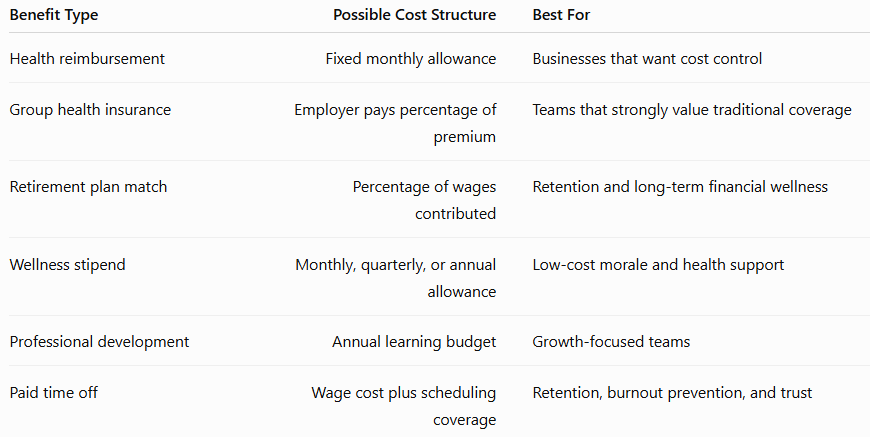
A monthly view also helps you phase benefits in gradually. You might start with $200 per employee per month for health support, then add retirement contributions next year, then expand paid leave after revenue grows. This phased approach is not a weakness. It is often the smartest way to build benefits because it lets you test what employees actually use before committing to a bigger package. Benefits should grow like a healthy tree, not explode like fireworks and disappear.
You should also build in renewal increases. Health insurance premiums can rise. Software platforms may change pricing. A retirement plan may become more expensive as participation grows. Paid time off may require more coverage as your team expands. Create a cushion in your budget so one renewal notice does not throw your entire plan into panic. A realistic benefits budget includes today’s cost and tomorrow’s likely increase.
Most importantly, do not hide the value of benefits from employees. Many employees see only their paycheck and forget the employer’s contribution behind the scenes. When you provide an annual total compensation statement, even a simple one, employees can see salary plus health contributions, PTO value, retirement match, stipends, payroll taxes, and other support. That does not replace fair pay, but it helps employees understand the full investment you are making in them.
Step 3: Choose Your Core Benefits
Once you understand employee priorities and your budget, choose your core benefits. Core benefits are the foundation of your package. They are the benefits most likely to affect hiring, retention, and employee well-being. For most small businesses, the core group includes health support, paid time off, flexibility, and some form of retirement savings. You may not offer all of these immediately, but they should be on your roadmap.
The biggest mistake is trying to offer too many scattered perks before covering the basics. A team may appreciate free coffee, birthday lunches, or casual Fridays, but those things rarely replace healthcare, time off, or financial security. Perks are decoration. Core benefits are structure. You need the structure first. Imagine building a house and picking curtains before installing the roof. That is what it feels like when a company offers fun perks while ignoring basic employee needs.
Core benefits also make your job postings stronger. When candidates compare opportunities, they look for signals of stability and professionalism. A small business that clearly lists health support, PTO, flexibility, retirement options, and growth opportunities feels more established than one that says “competitive benefits” without details. Be specific. Candidates trust clear information more than vague promises. “We offer a monthly health reimbursement, 15 days of PTO, flexible scheduling, and a SIMPLE IRA match” is stronger than “great benefits.”
As you choose your core benefits, think about fairness. Benefits should be consistent, documented, and easy to explain. That does not mean every employee must receive the exact same thing in every situation, because eligibility may vary by full-time status, role, location, or legal requirements. But the rules should be clear. Confusing benefits create resentment. Clear benefits create confidence. When people understand what is offered, who is eligible, and how to use it, the package becomes much more valuable.
Health Insurance Options
Health insurance is often the most requested and most complicated small business benefit. Employees value it because healthcare costs can be unpredictable and stressful. Employers worry about it because premiums can be expensive and plan choices can feel overwhelming. The right path depends on your team size, location, budget, employee needs, and administrative capacity. You may choose traditional group health insurance, a health reimbursement arrangement, marketplace support, or a combination of options.
For many small businesses, working with a licensed health insurance broker is helpful. A broker can explain plan options, carrier networks, contribution rules, enrollment timelines, and compliance responsibilities. Some brokers are paid through carrier commissions, while others may charge fees, so ask how compensation works. You want someone who explains trade-offs clearly instead of pushing the plan that sounds impressive but does not fit your budget. Good benefits advice should feel like a flashlight, not a sales pitch.
When comparing health options, pay attention to premiums, deductibles, copays, out-of-pocket maximums, provider networks, prescription coverage, and employee contribution amounts. A plan with a low monthly premium may have a high deductible that employees struggle to afford. A richer plan may be too expensive for the business to sustain. There is usually a trade-off. Your goal is not to find a perfect plan. Your goal is to find a plan that balances cost, access, and usability.
Also consider employee geography. If your team works in one city, a local network may be fine. If employees are spread across states, network access becomes more complicated. Remote teams may need different solutions than local teams. This is one reason HRAs have become more attractive for some small businesses. They can provide flexibility while helping employers control costs. Still, the rules matter, so do not wing it. Health benefits touch taxes and compliance, and small mistakes can become expensive.
Group Health Insurance
Group health insurance is the traditional route. The employer chooses one or more health plans and usually pays part of the employee premium. Employees enroll during an open enrollment period or when they become eligible. This option can be attractive because it is familiar, structured, and often valued by employees. It can also make your business look more established when recruiting candidates who expect employer-sponsored coverage.
The downside is cost and complexity. Premiums can be high, especially for very small teams. Participation requirements may apply depending on the carrier and market. You may need to decide how much of the employee premium you will cover and whether you will contribute toward dependents. Employees may still find coverage expensive if family premiums are high. That can create frustration if the business says it offers insurance but employees feel they cannot afford to use it.
Group plans can work well when your team values traditional coverage and your budget can support predictable employer contributions. They may also work well when employees are mostly in the same location and provider networks are strong. The experience can be smoother when you use payroll integration and benefits administration tools, because deductions, enrollment changes, and documents can otherwise become a lot to manage manually.
Before choosing a group plan, compare at least a few options. Do not focus only on the cheapest premium. Look at the total employee experience. Can employees keep their doctors? Are prescriptions covered reasonably? Are deductibles realistic? Is customer support decent? A benefit that looks good on paper but creates headaches every time someone uses it can damage trust. Health insurance is emotional because it touches families, illness, and money. Choose carefully.
HRA Options: ICHRA and QSEHRA
A Health Reimbursement Arrangement, or HRA, lets an employer reimburse employees for eligible healthcare expenses, often including individual health insurance premiums, within set rules. Two common options for small employers are QSEHRA and ICHRA. These arrangements can be appealing because they allow the business to set a defined contribution instead of taking on unpredictable premium increases in the same way as a traditional group plan. For small businesses that need cost control, that can be a major advantage.
A QSEHRA, or Qualified Small Employer HRA, is designed for eligible small employers that do not offer a group health plan. The employer sets a monthly reimbursement allowance, and employees can use it for qualified medical expenses if they meet the required conditions. A ICHRA, or Individual Coverage HRA, can offer more design flexibility and may be used by employers of different sizes, but employees generally need individual health insurance coverage to participate. Rules, limits, notices, and eligibility requirements can change, so always confirm current guidance with a qualified benefits advisor, tax professional, or official government source before launching one.
HRAs can be especially useful when your employees have different healthcare needs. One employee may want a marketplace plan with a broad network. Another may prefer a lower-premium plan. Another may have coverage through a spouse and use reimbursements differently if allowed. Instead of forcing everyone into the same group plan, an HRA can give employees more choice while giving the employer a clear budget. That flexibility is one of the biggest reasons small businesses consider this route.
The challenge is communication. HRAs are less familiar than traditional insurance, so employees may need help understanding how reimbursement works, what documentation is required, and how to shop for individual coverage. A good HRA administrator can make a big difference. Without clear instructions, employees may feel confused and undervalue the benefit. With strong communication, an HRA can feel empowering because employees see a direct monthly contribution toward their healthcare.
Retirement Plans
Retirement benefits are not just for big companies. Small businesses can offer retirement plans too, and doing so can help employees feel like they are building a future, not just earning a paycheck. For many workers, retirement savings can feel distant and overwhelming. When an employer provides a simple plan and possibly a match, it nudges employees toward long-term financial health. That kind of support can build loyalty because it shows you care about their life beyond the next pay period.
Common options include SIMPLE IRA plans, SEP IRAs, and 401(k) plans designed for small businesses. A SIMPLE IRA is often easier to administer than a traditional 401(k), making it attractive for smaller teams. SEP IRAs may suit certain owner-heavy or variable-income businesses, though they work differently and may not fit every employee retention goal. Small business 401(k) options have become more accessible through modern providers, but they still require attention to fees, compliance, payroll integration, and plan design.
A retirement match can be powerful even when it is modest. For example, matching a percentage of employee contributions up to a certain limit encourages participation and rewards employees who save. It also gives you a benefit that grows with payroll rather than a fixed stipend that may feel disconnected from earnings. Employees often view a match as “free money,” which makes it psychologically valuable. That perception can improve participation and appreciation.
When choosing a retirement plan, pay close attention to fees and employee education. Some plans have low employer costs but high investment fees that quietly eat into employee returns. Others offer strong tools, simple onboarding, and helpful education. Retirement benefits can be confusing, so plain-language guidance matters. You do not need to become a financial advisor, and you should not give personalized investment advice unless qualified, but you can choose a provider that makes saving easier for your team.
Paid Time Off and Flexibility
Paid time off is one of the most human benefits you can offer. People get sick. Kids have school events. Parents need care. Burnout happens. Life does not politely wait outside the office door until 5 p.m. When employees have paid time off, they can handle life without feeling punished financially. That reduces stress and helps people return to work with more focus. For small businesses, PTO can also prevent the hidden cost of presenteeism, where employees show up physically but are too exhausted, sick, or distracted to do good work.
Your PTO policy should be clear and realistic. Decide how many days employees receive, how PTO accrues, whether unused time rolls over, how requests are approved, and what happens when someone leaves the company. You may offer separate vacation and sick time, or combine them into one PTO bank. Some businesses offer unlimited PTO, but that can backfire if the culture discourages people from actually taking time off. A clear, finite policy is often easier for small businesses to manage.
Flexibility can be just as valuable as paid days off, and sometimes it costs less. Flexible start times, compressed workweeks, remote work days, shift swapping, or appointment-friendly scheduling can make a huge difference. For hourly teams, predictability may matter more than remote work. For office teams, hybrid schedules may be a major retention driver. The right flexibility depends on how your business operates. A bakery, plumbing company, salon, and accounting firm cannot all use the same model.
The best flexibility policies balance trust with business needs. Employees should understand what flexibility is available and what responsibilities still must be met. Customers still need service. Deadlines still matter. Coverage still matters. But when you treat employees like adults, many respond with greater commitment. Flexibility says, “We trust you to manage your work and your life.” For many people, that trust is worth more than another trendy perk.
Step 4: Add Low-Cost, High-Impact Perks
Once your core benefits are in place or at least planned, you can add low-cost perks that make daily work better. These perks do not have to be flashy. In fact, the best ones are often simple, practical, and deeply appreciated. A small monthly wellness stipend, a learning budget, a paid volunteer day, a home office allowance, or flexible Fridays can create goodwill without crushing your budget. The key is to choose perks that connect to real employee needs.
Low-cost perks work best when they are easy to use. If employees need to fill out five forms to get reimbursed for a $25 wellness expense, they may not bother. If a professional development stipend requires complicated approvals, it may sit unused. Keep the process simple. Make eligibility clear. Set reasonable limits. The easier a perk is to understand and use, the more valuable it feels. A benefit employees cannot access is basically office wallpaper.
You can also create perks around recognition and belonging. Small businesses have an advantage here because leaders often know employees personally. Celebrating work anniversaries, recognizing wins, offering team lunches, giving spot bonuses when possible, or providing extra time off after intense work periods can build a warm culture. These gestures should not replace core benefits, but they can strengthen the emotional connection employees feel with the business.
Be careful not to confuse perks with benefits in your communication. If your job posting says “great benefits” and then lists snacks, casual dress, and team outings, candidates may feel misled. Call perks perks. Call benefits benefits. Employees appreciate honesty. A small but clear package is better than an inflated one. When you describe your offering accurately, you attract people who value what you truly provide instead of disappointing people who expected something else.
Wellness, Mental Health, and Professional Development
Wellness benefits have evolved far beyond gym discounts. Today, employees may value mental health support, stress management resources, therapy access, meditation apps, ergonomic equipment, walking challenges, nutrition coaching, or simply permission to disconnect after work. For a small business, wellness does not need to become a huge program. It can start with small choices that protect energy and reduce burnout. Sometimes the most meaningful wellness benefit is a manager who does not message employees at midnight.
Mental health support is especially important because stress affects performance, attendance, communication, and retention. You might offer an Employee Assistance Program, a mental health stipend, access to counseling platforms, or paid mental health days. Even if your budget is limited, you can build a healthier culture by training managers to spot burnout, encouraging time off, and normalizing conversations about workload. Benefits are not only things you buy. They are also habits you build.
Professional development is another high-impact benefit because it helps employees grow while helping your business gain stronger skills. You can offer an annual learning stipend, pay for certifications, provide access to online courses, reimburse books, host lunch-and-learns, or create mentorship opportunities. Employees often stay longer when they feel they are learning. Nobody wants to feel like a phone battery stuck at 12%. Growth recharges people.
A good development benefit should connect employee goals with business needs. Ask employees what skills they want to build, then identify where those skills support company growth. For example, a customer service employee may want training in operations. A junior marketer may want analytics certification. A team lead may need management coaching. When you invest in development, you are not just being generous. You are building internal capability, reducing future hiring costs, and showing employees that their future matters.
Step 5: Compare Providers and Administration Tools
Choosing benefits is only half the job. You also need a way to manage them. Small businesses often underestimate administration until enrollment forms, payroll deductions, reimbursements, employee questions, tax documents, and renewal deadlines start piling up. A benefit that is hard to administer can become a source of frustration for everyone. That is why the right provider or platform matters. You want benefits that are not only valuable but also manageable.
Providers may include insurance brokers, payroll companies, benefits administration platforms, retirement plan providers, HRA administrators, HR software tools, and professional employer organizations. Each option has trade-offs. A broker may provide personal guidance but not a full software system. A payroll company may integrate deductions smoothly but offer limited plan choice. A PEO may bundle HR, payroll, compliance, and benefits access, but it can be more expensive and may reduce flexibility. The best choice depends on your size, complexity, budget, and internal capacity.
Ask how the provider supports employees, not just employers. Employees will have questions during enrollment, when using benefits, and when life changes happen. If all questions come back to you, the provider is not reducing your workload as much as promised. Good support can prevent confusion and help employees appreciate the benefits you are paying for. Poor support can make even a strong benefits package feel broken.
Also think about scalability. A tool that works for five employees may not work for 30. A manual spreadsheet may be fine at first, but eventually you may need online enrollment, automated reminders, payroll syncing, document storage, and reporting. Do not overbuy software before you need it, but do choose systems that can grow with you. Benefits should become easier as you grow, not heavier.
What to Look for Before You Sign
Before signing with any provider, compare more than price. Price matters, but it is only one piece of the puzzle. Look at plan quality, customer support, employee experience, compliance help, reporting, integrations, contract terms, cancellation rules, and renewal process. A cheap provider that disappears after the sale can cost you more in time, errors, and employee frustration. A slightly more expensive provider with strong support may be worth it.
Ask direct questions. Who handles employee questions? How fast does support respond? Does the platform integrate with your payroll system? What reports are available? Are compliance notices included? What happens during open enrollment? Are there setup fees, monthly minimums, or hidden charges? Can the provider support employees in multiple states? What happens if your headcount changes? These questions may feel detailed, but they help you avoid surprises.
You should also ask for demos and sample employee communications. Many platforms look great from the employer dashboard but feel confusing to employees. If employees cannot figure out how to enroll, submit receipts, compare plans, or update information, the benefit loses value. The employee experience should be clean, simple, and mobile-friendly when possible. People are used to intuitive apps. Clunky systems make benefits feel like homework.
Finally, check whether the provider explains things in plain English. Benefits are already full of acronyms and rules. You do not need a partner who makes everything sound more complicated. The best providers translate complexity into clear choices. They help you understand risks, responsibilities, and options without burying you in jargon. When a provider communicates clearly before the sale, there is a better chance they will communicate clearly after it.
Step 6: Handle Compliance, Taxes, and Documentation
Benefits come with rules, and small businesses should take those rules seriously. Depending on where you operate, your size, and the benefits you offer, you may need to follow federal, state, and local requirements related to health coverage, paid sick leave, retirement plans, tax treatment, nondiscrimination, employee notices, payroll deductions, and recordkeeping. This is not the fun part of offering benefits, but it protects your business and your employees.
Start by documenting every benefit in writing. Your policies should explain eligibility, enrollment, employer contributions, employee costs, deadlines, usage rules, reimbursement procedures, and what happens when employment ends. Do not rely on verbal promises. Verbal promises create confusion because people remember conversations differently. Written policies create consistency. They also help managers answer questions correctly instead of improvising.
Tax treatment matters too. Some benefits may be tax-advantaged if structured correctly. Others may count as taxable income. For example, certain reimbursements must follow specific rules to remain tax-free. Retirement contributions have plan requirements. Stipends may be taxable depending on how they are designed. This is where a qualified CPA, payroll provider, benefits advisor, or employment attorney can save you from expensive mistakes. Paying for good advice upfront is often cheaper than fixing errors later.
You should also keep compliance current. Laws change. Contribution limits change. State and local requirements change. Employee eligibility may change as your headcount grows. A business with 8 employees may have different obligations than one with 55. Do not assume the policy you wrote three years ago still works. Schedule a benefits review at least once a year, ideally before renewals and open enrollment. Think of it like changing the oil in your car. It is not glamorous, but it keeps the engine from failing.
Step 7: Launch, Communicate, and Improve Your Benefits Package
A benefits package is only valuable if employees understand it. You can spend thousands of dollars on benefits, but if employees do not know what is available, how to enroll, or why it matters, the value disappears. Communication is not a side task. It is part of the benefit. When you launch your package, explain it clearly, repeat the key points, and give employees chances to ask questions privately. Benefits involve personal finances and health, so people may not want to ask everything in a group meeting.
Use plain English. Instead of saying, “We are implementing a defined contribution healthcare strategy through a compliant reimbursement arrangement,” say, “The company will reimburse eligible healthcare costs up to a set monthly amount, and here is how you submit expenses.” Instead of saying, “Employees are eligible after the first of the month following 60 days,” show examples with dates. The clearer you make the process, the more confident employees will feel.
Create a simple benefits guide. It does not need to be fancy. Include what each benefit is, who is eligible, what the company pays, what employees may pay, how to enroll, deadlines, contact information, and examples. You can also include a total compensation snapshot so employees understand the full value. Many employees underestimate employer-paid benefits because the money does not always appear directly in their paycheck. Showing the value helps them see the complete picture.
After launch, keep improving. Track participation, usage, employee questions, renewal increases, and survey feedback. If no one uses a perk, ask why. Maybe employees do not value it. Maybe they forgot about it. Maybe the process is too difficult. If health premiums rise sharply, compare alternatives before renewal. If employees keep asking for flexibility, revisit scheduling. Benefits should not be frozen in time. A good benefits package is a living system that grows with your people and your business.
Conclusion
Offering benefits as a small business does not have to be overwhelming. Start with your employees, not with a brochure. Ask what they value, set a budget you can sustain, choose core benefits first, and add low-cost perks that make everyday work better. Health insurance, HRAs, retirement plans, paid time off, flexibility, wellness support, and professional development can all play a role, but the right mix depends on your team and your finances. You do not need to build the perfect package overnight. You need to build a thoughtful one that employees understand and trust.
The best small business benefits strategy is practical, clear, and human. It recognizes that employees have real lives outside work and that a business becomes stronger when its people feel supported. Benefits can help you hire better, retain longer, reduce burnout, and create a culture where people want to contribute. Start small if you need to. Be transparent about what you can offer. Review the package regularly. Improve it as your business grows. That steady, honest approach often beats a flashy benefits plan that no one understands or uses.
FAQs
1. What benefits should a small business offer first?
Most small businesses should start with the benefits employees value most, usually health support, paid time off, schedule flexibility, and retirement savings. The exact order depends on employee feedback and budget. A simple survey can help you choose wisely instead of guessing.
2. Can a small business offer benefits without offering group health insurance?
Yes. Some small businesses use options like HRAs, wellness stipends, paid time off, flexible scheduling, or retirement plans. HRAs such as ICHRA or QSEHRA may help employers support healthcare costs without a traditional group plan, but rules should be checked before setup.
3. How much should a small business budget for employee benefits?
There is no single number that fits every business. A practical approach is to calculate what you can afford per employee per month, then choose benefits that fit that amount. Start sustainable, build in room for increases, and expand as revenue grows.
4. Are employee benefits tax-deductible for small businesses?
Many employee benefits may be deductible as business expenses if structured correctly, but tax treatment varies by benefit type and location. Health plans, retirement contributions, and reimbursements often have specific rules. A CPA or benefits advisor should review your setup.
5. How do I make employees appreciate the benefits I offer?
Communicate clearly and often. Give employees a simple benefits guide, explain the company’s contribution, provide examples, and remind people during the year. A total compensation statement can also help employees see the real value beyond their paycheck.
SOURCEs
https://www.kff.org/report-section/ehbs-2024-summary-of-findings/
https://www.healthcare.gov/job-based-help/ichra/
https://www.dol.gov/general/topic/health-plans
https://www.irs.gov/retirement-plans/retirement-plans-for-small-entities-and-self-employed
https://www.irs.gov/retirement-plans/plan-sponsor/simple-ira-plan
https://www.irs.gov/retirement-plans/plan-sponsor/simplified-employee-pension-plan-sep