Reducing Employee Health Care Costs: The Smart Action Organizations Should Take

When people ask, “Which action helps organizations reduce the cost of health care benefits offered to employees?” the strongest answer is this: organizations should invest in employee wellness and preventive health programs that help workers stay healthier, manage risks earlier, and avoid expensive medical claims later. That sounds simple, but the real magic is in how the program is built. A random step-count contest or a once-a-year wellness flyer will not move the needle much. A thoughtful strategy that combines preventive care, chronic condition support, mental health resources, telehealth, smarter pharmacy choices, and employee education can actually change how people use health care.
Think of health care costs like a roof leak. You can ignore the small drip for months, but eventually you are replacing drywall, flooring, insulation, and maybe half the ceiling. Preventive health works the same way. A blood pressure screening, cancer screening, mental health visit, medication review, or nutrition coaching session may seem small today, but it can prevent a much bigger cost tomorrow. For employers, that means fewer high-cost claims, fewer avoidable emergency room visits, lower absenteeism, and a workforce that feels supported instead of squeezed.
The goal is not to push employees into uncomfortable programs or make health benefits feel like surveillance. The goal is to create a workplace culture where staying healthy is easier than ignoring health. Employees are more likely to participate when programs are convenient, confidential, inclusive, and clearly connected to their real lives. When organizations treat wellness as a practical business strategy rather than a decorative HR perk, the results can be meaningful. The smartest action is not just cutting benefits. It is helping employees use care earlier, better, and more confidently.
Why Health Care Benefit Costs Feel So Hard to Control
Health care benefit costs are difficult to control because they are shaped by many moving parts at the same time. Employers are not just paying for doctor visits. They are dealing with hospital charges, prescription drug costs, chronic disease management, emergency care, specialty care, insurance administration, employee demographics, medical inflation, and sometimes low health literacy. When all those pieces move upward together, benefits can start to feel like a runaway train. The frustrating part is that many organizations only see the final bill after employees have already needed expensive care.
Another challenge is that health care is often reactive. Many people wait until symptoms are painful, scary, or impossible to ignore before they seek help. That delay can turn manageable conditions into expensive claims. A person with untreated high blood pressure may eventually need emergency care. An employee with unmanaged diabetes may face complications that require specialist visits, medication changes, or hospitalization. A worker struggling with stress or depression may miss work, lose productivity, or use more medical services without getting the right support early. None of these situations happen overnight. They build quietly in the background.
Organizations also face the human side of benefits. Employees may not understand their plan, may avoid care because of cost concerns, or may not know which option to choose. Should they go to urgent care, telehealth, primary care, or the emergency room? Should they use a generic drug? Should they ask for a second opinion before surgery? These decisions affect cost, but employees often make them under stress. Without guidance, people choose what feels fastest or safest, and that is not always the most cost-effective option.
That is why simply shifting costs to employees rarely solves the problem. Higher deductibles and higher premiums may reduce employer spending in the short term, but they can also cause employees to delay care. Delayed care often returns later as bigger, more expensive treatment. A better strategy is to reduce avoidable costs while preserving access to useful care. That is where preventive health programs, wellness initiatives, benefits education, and care navigation become powerful. They help employees make better health decisions before small issues become major expenses.
The Best Action: Build a Preventive, Wellness-First Benefits Strategy
The best action organizations can take to reduce employee health care benefit costs is to build a preventive, wellness-first benefits strategy. This means the employer actively supports healthier behaviors, earlier screenings, better disease management, and smarter use of medical services. It is not about forcing employees to become marathon runners or eat salads at every meal. It is about removing friction from healthier choices. When prevention becomes easy, normal, and accessible, employees are more likely to use it.
A strong wellness-first strategy usually includes several connected pieces. Employees need access to preventive screenings, annual checkups, vaccinations, health risk assessments, mental health resources, fitness support, nutrition education, smoking cessation support, and chronic disease coaching. They also need simple explanations of how to use their benefits. A beautiful insurance plan is not very helpful if employees do not understand where to go, what is covered, or how to avoid unnecessary costs. Education is part of prevention because confusion itself can be expensive.
The most effective programs also respect employee privacy. People will not participate honestly if they feel their employer is watching their medical information. Trust is the engine of wellness participation. Employees need to know that health information is protected, that participation is fair, and that the goal is support rather than punishment. A wellness program that feels judgmental will collapse quickly. A program that feels practical, confidential, and useful has a much better chance of becoming part of workplace culture.
This approach reduces costs because it changes the timing and quality of care. Instead of waiting for expensive problems, the organization encourages early action. Instead of employees guessing where to go, the program helps them choose the right care setting. Instead of unmanaged chronic conditions driving claims upward, employees receive tools and support to manage their health. The result is not instant savings overnight, but a healthier cost curve over time. For many organizations, that is exactly what they need: not a gimmick, but a durable way to make health benefits more sustainable.
How Preventive Care Lowers Claims Before They Become Expensive
Preventive care lowers costs because it catches health risks while they are still easier and cheaper to manage. This is the same logic behind changing the oil in a car. You do not wait for the engine to smoke on the highway before paying attention. You handle the small maintenance task because it protects the larger system. In employee health care, preventive services work the same way. Screenings, checkups, immunizations, and early consultations can help identify problems before they become severe.
For example, regular blood pressure checks can reveal hypertension before it leads to a stroke or heart-related emergency. Blood sugar testing can identify diabetes risk before complications develop. Cancer screenings can detect certain cancers earlier, when treatment may be more effective and less complex. Flu shots and other vaccinations can reduce illness-related absences and prevent outbreaks that disrupt teams. Even routine primary care visits can make a difference because they create a relationship between the employee and a provider who can guide health decisions over time.
Preventive care also helps employees avoid unnecessary emergency room visits. Many high-cost claims begin when someone does not know where else to go or waits until the situation feels urgent. When employees have access to primary care, telehealth, nurse lines, or care navigation, they are more likely to choose the right level of care. That matters because emergency care is usually one of the most expensive settings. Helping employees use care earlier and appropriately can reduce waste without reducing quality.
A good employer strategy makes preventive care visible and easy. Employees should not have to dig through complicated benefit documents to learn that screenings or annual visits are available. HR teams can use simple reminders, benefit guides, webinars, manager toolkits, and enrollment materials to encourage use. The tone should be helpful, not preachy. A message like “Here are three covered preventive services that could save you money and stress this year” is more effective than a generic warning about health risks. When preventive care feels like a normal part of working life, it becomes one of the most practical ways to reduce long-term benefit costs.
Why Chronic Condition Support Matters More Than Most Employers Realize
Chronic conditions are one of the biggest drivers of health care spending for employers because they often require ongoing care, medication, testing, specialist visits, and sometimes hospitalization. Conditions such as diabetes, heart disease, asthma, hypertension, obesity-related complications, back pain, depression, and anxiety can affect both claims and workplace productivity. The cost is not only medical. Employees dealing with unmanaged chronic conditions may miss work more often, feel less focused, or struggle with energy throughout the day. That hidden productivity cost can be just as serious as the insurance claim.
The key word is unmanaged. Many chronic conditions can be controlled more effectively when people have the right support. That might include coaching, medication adherence help, disease management programs, nutrition counseling, exercise support, remote monitoring, or regular check-ins with providers. The goal is not to “fix” employees. The goal is to help them stay stable, avoid complications, and feel more in control of their health. When chronic conditions are managed well, costly flare-ups and emergency interventions may become less frequent.
Employers should also understand that chronic condition support works best when it is practical. Telling someone with diabetes to “eat better” is not a strategy. Helping them access affordable medication, understand their nutrition options, schedule regular checkups, and communicate with a care team is a strategy. Telling someone with chronic back pain to “exercise more” may feel dismissive. Offering physical therapy access, ergonomic support, movement education, and early treatment pathways is far more useful. Employees need specific tools, not vague encouragement.
This is where wellness programs become more than posters and slogans. A mature wellness strategy identifies common health risks across the workforce and connects employees to resources that match those risks. Employers can look at aggregated, privacy-protected claims data, health risk assessments, absenteeism trends, and employee feedback to understand where support is needed. When chronic condition programs are targeted and compassionate, they can reduce high-cost claims while improving quality of life. That is a rare win-win in benefits management, and it is one of the reasons preventive wellness is such a strong cost-reduction action.
Designing Wellness Programs Employees Actually Use
A wellness program only works when employees actually use it. That may sound obvious, but many organizations forget it. They design programs that look impressive in a benefits presentation but feel inconvenient or irrelevant in real life. Employees are busy. They have families, deadlines, commutes, bills, health worries, and personal preferences. If a wellness program adds another complicated task to their day, participation will be weak. A good program should feel like a bridge, not a hurdle.
The best employee wellness programs are built around real employee needs. A workforce with many desk-based employees may need movement breaks, ergonomic support, mental health resources, and back pain prevention. A manufacturing workforce may need injury prevention, fatigue management, safety-focused wellness, and easy onsite screenings. A remote workforce may need virtual fitness options, telehealth, digital mental health tools, and social connection. There is no universal wellness recipe. The program should match the people it is meant to serve.
Communication also matters. Employees rarely read long benefits documents unless they are already confused or frustrated. Wellness communication should be simple, repeated, and human. Instead of saying, “Participate in biometric screening to optimize health outcomes,” say, “Get a quick health check so you know your numbers and can catch problems early.” Plain language builds trust. HR teams should explain what is available, why it matters, how privacy works, and how employees can participate without feeling embarrassed or judged.
A useful wellness program also gives employees multiple doors to enter. Not everyone wants a gym challenge. Some people want mental health counseling. Some want help sleeping better. Some want nutrition support. Some want financial wellness because money stress is affecting their health. Some need help managing medication. When a program offers several pathways, more employees can find something that fits. That is important because broad participation spreads the benefits across the organization. A wellness-first strategy should feel less like a corporate campaign and more like a well-stocked toolbox.
Start With Data Instead of Guesswork
Organizations should start with data because guessing can lead to expensive programs nobody needs. HR leaders may assume employees want fitness discounts, while the workforce may be struggling more with stress, sleep, diabetes, or medication costs. Without data, wellness planning becomes a game of darts in the dark. With data, employers can focus their budget on the areas most likely to reduce costs and improve employee well-being.
The right data should be aggregated and privacy-protected. Employers do not need to know an individual employee’s private diagnosis. They need broad patterns. Claims reports, pharmacy trends, absence data, employee surveys, occupational injury reports, utilization data, and health risk assessments can all help identify needs. For example, if pharmacy costs are rising quickly, the organization may need stronger prescription education, formulary guidance, or medication management support. If musculoskeletal claims are common, ergonomic assessments and physical therapy access may make sense. If mental health claims and absenteeism are increasing, employee assistance programs and therapy access may deserve more investment.
Employee feedback is just as important as claims data. Numbers can show what is happening, but employees can explain what it feels like. Maybe employees are not using preventive care because appointment times are inconvenient. Maybe they do not trust the wellness vendor. Maybe they do not understand the plan. Maybe they want help but fear stigma. Surveys, listening sessions, and anonymous feedback channels can reveal barriers that spreadsheets miss. Health care cost control is not only a finance problem. It is a human behavior problem.
Data also helps organizations avoid copying trends blindly. Just because another company launched a popular wellness app does not mean that app will solve your cost problem. The right question is not, “What wellness program is trendy?” The right question is, “What health risks, access issues, and cost drivers are most important for our workforce?” Once employers answer that, they can build a program with purpose. Data turns wellness from a nice idea into a targeted strategy.
Make Participation Easy, Private, and Inclusive
Employees are far more likely to join wellness programs when participation is easy, private, and inclusive. Convenience is not a small detail. It is often the difference between a program that gets used and a program that gets ignored. If employees have to complete five forms, create a confusing portal account, attend a session at a bad time, or travel across town for a screening, many will skip it. People may care about their health, but friction wins more often than employers realize.
Easy participation means meeting employees where they are. Onsite screenings can help employees who cannot easily schedule appointments during work hours. Virtual coaching can help remote employees and caregivers. Mobile-friendly tools can help workers who do not sit at a desk. Flexible scheduling can help shift workers. Clear instructions can help everyone. The experience should feel simple from the employee’s point of view: here is what is available, here is how to use it, here is what it costs, and here is what happens next.
Privacy is equally important. Employees need confidence that their medical information will not be used against them. If a wellness program feels like surveillance, participation will drop and trust will suffer. Organizations should explain how personal health information is protected, who manages the data, and what the employer can and cannot see. The message should be repeated often because privacy concerns do not disappear after one open enrollment meeting. Trust is built through consistency.
Inclusivity means designing programs for different ages, abilities, cultures, family situations, income levels, and health statuses. A weight-loss challenge may motivate some employees but alienate others. A gym reimbursement may help people who already like gyms but do little for someone with mobility limitations, caregiving responsibilities, or anxiety about fitness spaces. Inclusive wellness focuses on practical health support rather than narrow ideals. It gives employees options and respects that health is personal. When people feel seen instead of judged, they are more willing to participate. That participation is what allows wellness programs to reduce costs at scale.
Incentives That Motivate Without Feeling Punitive
Incentives can help wellness programs gain traction, but they must be designed carefully. A good incentive feels like encouragement. A bad incentive feels like punishment wearing a friendly mask. Employees can quickly tell the difference. If a wellness program rewards only people who already have strong health numbers, it may discourage the people who need support most. If it penalizes employees who cannot participate because of disability, schedule, caregiving duties, or medical conditions, it can create resentment and legal risk.
The best incentives reward effort and engagement rather than perfect outcomes. For example, employees might earn a premium discount, gift card, wellness credit, or health savings account contribution for completing a preventive checkup, attending a coaching session, taking a health assessment, joining a smoking cessation program, or participating in a mental health workshop. These actions are within reach for more people. They encourage employees to take steps without demanding that everyone achieve the same result. Health is not a straight road. Some people are climbing hills others cannot see.
Incentives should also be meaningful but not manipulative. A tiny reward may not get attention, while an overly large penalty may feel coercive. The tone matters. Employees should hear, “We want to support your health and make it easier to get care,” not “Prove you are healthy or pay more.” That difference shapes how people talk about the program in break rooms, team chats, and employee forums. Culture can make or break participation.
Employers should also keep incentives simple. Complicated points systems can become confusing, especially if employees do not understand how to earn rewards or when they will receive them. A clear structure works better: complete these steps, receive this reward, by this date. When incentives are fair, transparent, and connected to useful health actions, they can boost engagement without damaging trust. The real purpose is not bribery. The purpose is to nudge employees toward preventive care and healthier decisions that benefit both the employee and the organization.
Pair Wellness With Smarter Health Plan Design
Wellness programs become stronger when they are paired with smarter health plan design. A company can encourage employees to get preventive care, but the plan itself must make smart care affordable and accessible. If employees face confusing rules, high out-of-pocket costs, limited provider access, or poor support, they may delay care despite wellness messaging. The plan design should support the behavior the organization wants to encourage.
A smarter plan design often includes strong coverage for preventive services, affordable primary care, telehealth access, mental health support, care navigation, and transparent information about costs. It may also include incentives for using high-quality providers, centers of excellence, or second opinion services before major procedures. The goal is not to restrict employees in a harsh way. The goal is to guide them toward care that is effective, appropriate, and less wasteful. Think of it like placing clear signs on a busy road. People still choose where to go, but the right path is easier to find.
Plan design should also address the problem of delayed care. When employees avoid basic care because of cost, the organization may pay later through larger claims. Employers should look carefully at whether deductibles, copays, and coinsurance are discouraging useful early care. A plan that looks cheaper on paper may become expensive if it pushes people away from primary care and toward emergency care. Cost sharing needs balance. Employees should have enough information to make thoughtful choices, but they should not feel trapped between health and household finances.
Communication is part of plan design too. Even the best plan can fail if employees do not understand it. During open enrollment, HR teams should explain real-life scenarios: where to go for a minor illness, how telehealth works, how to compare medication options, how to find an in-network provider, and when to use urgent care instead of the emergency room. These practical examples can reduce confusion and lower unnecessary spending. Wellness and plan design should work together like two hands on the same wheel.
Telehealth, Care Navigation, and Second Opinions
Telehealth, care navigation, and second opinions can reduce costs by helping employees access the right care at the right time. Many employees do not need a high-cost setting for every health concern. A minor infection, medication question, rash, cold symptom, or follow-up conversation may be handled through telehealth when appropriate. That convenience can prevent employees from delaying care or choosing the emergency room because they do not know what else to do. Telehealth is not a replacement for all in-person care, but it is a useful doorway into the health system.
Care navigation is another powerful tool because health care can feel like a maze. Employees may not know which specialist to choose, whether a provider is in network, how much a procedure might cost, or what questions to ask. A care navigator can guide employees through these decisions. That support can reduce unnecessary visits, duplicate tests, surprise bills, and poor care choices. It can also reduce stress, which matters because stressed employees may make rushed decisions.
Second opinion programs are especially useful for major diagnoses, surgeries, or expensive treatment plans. When an employee is facing a serious medical decision, getting another expert review can confirm the original plan or reveal a less invasive option. This can prevent unnecessary procedures and help employees feel more confident. From the employer’s perspective, avoiding one unnecessary surgery or poorly matched treatment pathway can make a meaningful difference in claims costs. From the employee’s perspective, the value is even bigger because the decision affects their body and life.
The key is making these services easy to access before employees are in crisis. If telehealth requires a confusing login, care navigation is buried in a benefits PDF, or second opinions are mentioned only once during open enrollment, employees may forget they exist. Employers should communicate these resources repeatedly through simple examples. “Before scheduling a costly procedure, call this service for guidance” is more useful than a vague benefits description. When employees know where to turn, they make better choices.
Pharmacy Management and Generic Drug Education
Prescription drug spending can be a major pressure point in employee health care benefits. Some medications are essential, life-changing, and worth the cost. Others may have lower-cost alternatives that employees do not know about. Without guidance, employees may pay more than necessary, employers may absorb higher claims, and nobody realizes there was a better option. That is why pharmacy management and generic drug education belong inside a cost-reduction strategy.
Generic drugs can often provide the same active ingredient as brand-name medications at a lower cost, when clinically appropriate. Employees may not always understand this. Some people assume generic means weaker, lower quality, or less reliable. Clear education can correct those myths. Employers can encourage employees to ask their provider or pharmacist whether a generic or lower-cost therapeutic alternative is available. This should always be framed as a medical conversation, not a command. The employee’s clinician should guide what is safe and appropriate.
Pharmacy benefit design can also steer employees toward cost-effective choices. Mail-order programs, preferred pharmacies, formulary education, specialty drug management, and medication adherence support can all help. Specialty medications deserve special attention because they can be extremely expensive and may require careful coordination. A strong pharmacy program helps employees access the medication they need while reducing waste, duplication, and avoidable spending. It is not about denying care. It is about making sure the right medication is used in the right way at the right cost.
Education should be practical. Employees need to know how to check medication costs, what a formulary is, why prior authorization may happen, how to avoid running out of important medication, and who to call with questions. This is especially important for employees managing chronic conditions. Medication adherence can prevent complications, while confusion or unaffordable costs can lead people to skip doses. When pharmacy support is done well, it protects both health and benefits budgets. It is one of the quieter cost-saving actions, but it can be remarkably important.
Mental Health Support as a Cost-Control Strategy
Mental health support is not just a compassionate benefit. It is also a smart cost-control strategy. Stress, anxiety, depression, burnout, substance use issues, grief, and sleep problems can affect physical health, workplace safety, productivity, absenteeism, and medical spending. When employees cannot access mental health support early, problems can become more severe and more expensive. A person under heavy stress may experience headaches, stomach issues, high blood pressure, insomnia, or worsening chronic conditions. The mind and body are not separate departments.
Employers can support mental health through employee assistance programs, therapy benefits, teletherapy, manager training, stress management resources, crisis support, flexible work practices, and workload conversations. The most effective approach is not just offering a phone number. Many employees know an EAP exists but never use it because they do not understand it, trust it, or remember it during difficult moments. Communication must be human and repeated. Employees should understand that support is confidential and available before life feels unmanageable.
Manager behavior also matters. A workplace can offer excellent mental health benefits and still burn people out through unrealistic workloads, unclear expectations, or a culture that rewards constant availability. Health care costs are not only shaped by insurance design. They are shaped by work design. When employees feel psychologically safe, supported, and able to ask for help, they are more likely to address problems early. When they feel ashamed or afraid, they may hide struggles until the situation becomes serious.
Mental health care can also reduce costs connected to physical health claims. Employees with chronic conditions often do better when emotional stress is managed. Someone with diabetes, heart disease, chronic pain, or cancer may need mental health support to stay engaged in treatment. Ignoring mental health is like trying to fix a house while leaving the foundation cracked. A wellness-first benefits strategy should treat mental health as central, not optional. Supporting employees emotionally can reduce avoidable medical use, improve retention, and create a healthier workplace overall.
Comparing Cost-Saving Actions for Employee Health Benefits
Organizations have several options for reducing the cost of health care benefits, but not all actions create the same kind of value. Some strategies lower employer costs quickly but may shift financial burden to employees. Others take longer but improve health outcomes and reduce avoidable claims. The strongest approach usually combines prevention, education, plan design, and access support. Cutting benefits alone can look attractive in a budget meeting, but it may damage morale, retention, and long-term health.
A wellness-first strategy stands out because it targets root causes rather than just symptoms. It helps employees manage health risks before they become expensive. It also supports better decision-making. When employees understand where to get care, how to use preventive services, and how to manage chronic conditions, the organization can reduce waste without simply taking benefits away. That is why preventive wellness is often a better answer than cost shifting.
Here is a practical comparison of common approaches:
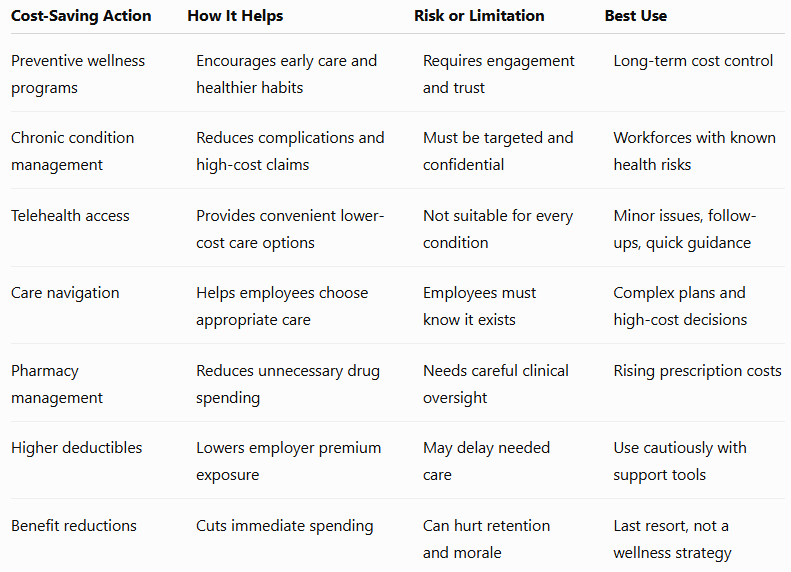
The table shows why the best action is not a single isolated tactic. The most sustainable answer is a connected system. Preventive care reduces future risk. Chronic condition support manages ongoing needs. Telehealth and navigation guide employees to appropriate care. Pharmacy education reduces waste. Mental health resources support the whole person. Together, these actions reduce costs more responsibly than simply making employees pay more. A healthy benefits strategy should save money without making employees feel abandoned.
Common Mistakes That Make Health Cost Programs Fail
Many health cost programs fail because they are built around employer goals without enough attention to employee experience. Leaders may want lower claims, lower premiums, and better renewal numbers. Employees, on the other hand, want affordable care, privacy, convenience, and respect. When a program speaks only the language of cost savings, employees may see it as a corporate expense-control tactic rather than a benefit. That perception matters because participation depends on trust.
One common mistake is launching generic wellness activities that do not match workforce needs. A company might offer a gym challenge when employees are more concerned about stress, sleep, childcare, or chronic pain. Another employer might invest in a wellness app while frontline workers rarely have time or access to use it. Programs fail when they are designed for an imaginary average employee instead of the real people doing the work. A good wellness strategy begins with listening.
Another mistake is communicating too little. HR teams often announce a program once and assume employees will remember it. They will not. People are flooded with emails, meetings, personal responsibilities, and daily tasks. Benefits communication needs repetition, clarity, and timing. Employees should hear about resources during open enrollment, onboarding, health observances, manager check-ins, and moments when the benefit is relevant. A care navigation service is more useful when employees remember it before scheduling a procedure, not after the claim has already happened.
Employers also fail when wellness feels judgmental. Programs focused too heavily on weight, appearance, or competition can alienate employees. Health is deeply personal, and many people carry shame, trauma, medical limitations, or past failures around it. A supportive program says, “Here are tools to help you feel better and get care earlier.” A poor program says, “Measure up or lose.” The difference is huge. To reduce health care benefit costs, organizations need engagement. To get engagement, they need trust. To earn trust, they need empathy.
How HR Can Measure ROI Without Oversimplifying the Results
Measuring the return on investment of wellness and preventive health programs can be tricky because health outcomes do not always show up immediately. A successful screening today may prevent a costly event years later. A mental health benefit may reduce turnover, absenteeism, and presenteeism in ways that are harder to connect to a single claim. A chronic condition program may not eliminate costs, but it may slow the rate of increase. That is still valuable. HR teams should measure ROI carefully without pretending every benefit can be reduced to one simple number.
A balanced measurement strategy should include both financial and human indicators. Financial measures may include total claims trends, emergency room utilization, hospital admissions, pharmacy spending, preventive care utilization, chronic condition program participation, and renewal rate changes. Human measures may include employee satisfaction, engagement, absenteeism, retention, productivity feedback, and perceived access to care. When these measures are viewed together, leaders get a more realistic picture.
Employers should also compare trends over time rather than expecting instant results. A wellness program launched in January may not dramatically reduce costs by June. Early signs may show up first in participation, preventive care use, telehealth visits, or employee feedback. Later, the organization may see fewer avoidable emergency visits, better chronic condition adherence, or slower claims growth. Health care cost control is more like gardening than flipping a switch. You plant, water, adjust, and watch patterns develop.
HR should be careful with ROI promises. Overpromising savings can damage credibility if results take longer or appear in indirect ways. A more honest goal is to build a healthier, better-informed workforce while reducing avoidable costs over time. That framing is both practical and believable. Leaders should ask, “Are employees using preventive care more? Are they choosing appropriate care settings? Are chronic conditions better supported? Are workers less confused about benefits?” Those questions reveal whether the strategy is working. The strongest ROI story combines numbers with real employee experience.
A Practical 90-Day Rollout Plan for Employers
A 90-day rollout can help organizations move from good intentions to real action. The first month should focus on discovery. HR, finance, benefits advisors, and leadership should review aggregated claims trends, pharmacy spending, preventive care utilization, absenteeism patterns, and employee feedback. The goal is to identify the top cost drivers and the biggest access barriers. This is not the time to buy random wellness tools. It is the time to understand the problem clearly.
During the second month, the organization should design the program around the findings. If preventive care use is low, create a campaign that explains covered screenings and annual checkups. If employees are using the emergency room for non-emergency needs, promote telehealth, urgent care education, and nurse lines. If chronic conditions are driving claims, introduce targeted coaching or disease management support. If mental health concerns are rising, strengthen therapy access, EAP communication, and manager education. The program should feel specific, not generic.
The third month should focus on launch and communication. Employees need simple messages, not benefits jargon. Use real-life examples: “Have a minor illness after hours? Start with telehealth.” “Planning a surgery? Use care navigation first.” “Taking a brand-name medication? Ask whether a generic option is available.” “Feeling overwhelmed? Confidential support is available.” These messages should appear in email, posters, intranet posts, manager talking points, onboarding materials, and open enrollment guides. Repetition is not annoying when the information is genuinely useful.
After launch, employers should track early indicators. Are employees signing up? Are they opening messages? Are they using telehealth, screenings, or coaching? Are managers comfortable pointing employees to resources? The organization should adjust quickly based on feedback. A 90-day rollout is not the finish line. It is the start of a cycle: listen, build, communicate, measure, improve. That rhythm turns wellness from a one-time campaign into a long-term cost-control strategy.
Conclusion
The action that best helps organizations reduce the cost of health care benefits offered to employees is implementing a preventive, wellness-first benefits strategy. This approach works because it focuses on the root causes of high costs: delayed care, unmanaged chronic conditions, confusion about benefits, avoidable emergency visits, medication waste, stress, and low engagement. Instead of simply cutting benefits or shifting costs to employees, organizations help workers get the right care earlier and use their benefits more wisely.
A strong strategy includes preventive screenings, chronic condition support, mental health resources, telehealth, care navigation, pharmacy education, and simple communication. It also respects privacy and gives employees realistic ways to participate. The best wellness programs do not shame people into health. They make healthy choices easier, more affordable, and more normal. That human-centered approach is what separates a meaningful strategy from a corporate checkbox.
Employers should remember that cost reduction is not only a financial project. It is a culture project. Employees need to trust the program, understand it, and see value in it. When wellness feels supportive, participation rises. When participation rises, organizations have a better chance of reducing avoidable claims and improving workforce well-being. Health care benefits will probably never feel cheap, but they can become more sustainable.
The smartest organizations do not wait for costs to explode before acting. They build systems that help employees stay healthier today so everyone pays less for preventable problems tomorrow. That is the real answer: invest in prevention, support people early, guide smarter care decisions, and treat employee health as a long-term business asset.
Frequently Asked Questions
Five Practical Answers for Employers
1. What is the single best action to reduce employee health care benefit costs?
The single best action is to implement a preventive employee wellness program that encourages early care, healthier habits, and better management of chronic conditions. This kind of program helps reduce expensive claims by addressing health risks before they become serious. It should include screenings, education, mental health support, chronic disease management, telehealth, and care navigation. The program works best when employees trust it and can participate easily.
2. Do wellness programs really save employers money?
Wellness programs can help reduce costs when they are targeted, well-communicated, and connected to real workforce needs. A generic wellness challenge may not produce meaningful savings, but a thoughtful program focused on prevention, chronic conditions, pharmacy choices, and mental health can reduce avoidable costs over time. Employers should measure success through claims trends, participation, preventive care use, absenteeism, and employee feedback. Savings are usually strongest when wellness is part of a broader benefits strategy.
3. How can small businesses reduce employee health care costs?
Small businesses can start with simple, practical steps. They can encourage preventive care, promote telehealth, educate employees about urgent care versus emergency care, support generic drug use when appropriate, and offer mental health resources. They can also work with brokers or benefits advisors to review plan options and identify cost drivers. A small business does not need a huge wellness department to make progress. Clear communication and smart benefit choices can go a long way.
4. Why is preventive care better than cutting employee benefits?
Preventive care helps reduce future costs without making employees feel unsupported. Cutting benefits may lower expenses in the short term, but it can also cause employees to delay care, which may lead to bigger claims later. Benefit cuts can hurt morale, retention, and employer reputation. Prevention protects access while reducing avoidable spending. It is a more sustainable and employee-friendly way to manage health care costs.
5. What should employers avoid when creating wellness programs?
Employers should avoid programs that feel invasive, judgmental, confusing, or disconnected from employee needs. They should not focus only on weight loss, fitness competitions, or penalties. They should also avoid collecting unnecessary personal health information or communicating in complicated benefits language. The best programs are private, inclusive, simple, and useful. Employees participate when they believe the program is truly designed to help them.
Sources
https://www.shrm.org/topics-tools/tools/toolkits/managing-health-care-costs
https://www.healthcare.gov/coverage/preventive-care-benefits/
https://www.dol.gov/agencies/ebsa
https://www.who.int/news-room/fact-sheets/detail/mental-health-at-work
https://www.heart.org/en/professional/workplace-health
https://www.cdc.gov/niosh/twh/
https://www.cms.gov/data-research/statistics-trends-and-reports/national-health-expenditure-data