Workers Rights Violations: Understanding, Identifying, and Combating Workplace Injustice

What Are Workers Rights Violations?
Definition and Core Concepts
Workers rights violations are more common than most people think, and they don’t always look like the dramatic cases you see in the news. Sometimes, they show up in subtle ways—like being asked to stay late without pay or being denied breaks you’re legally entitled to. At their core, workers rights violations occur when employers fail to comply with labor laws or deny employees the rights they are legally or ethically owed. These rights can include fair wages, safe working environments, freedom from discrimination, and protection against exploitation.
Think of workers rights as a basic contract between society and the workforce. When you show up, do your job, and contribute to an organization, there are certain guarantees that should come with that effort. These guarantees aren’t just “nice-to-haves”—they are fundamental protections that ensure dignity, fairness, and safety in the workplace. Without them, the balance of power tilts heavily toward employers, leaving workers vulnerable.
A key concept here is accountability. Employers are expected to follow labor standards set by governments and international bodies. When they don’t, it’s not just a minor oversight—it’s a violation that can have real consequences on workers’ lives. For example, missing wages might mean someone can’t pay rent, while unsafe conditions could lead to serious injury.
Another important angle is awareness. Many workers don’t even realize their rights are being violated because they’ve normalized unfair practices. If something feels off at work—like inconsistent pay, favoritism, or lack of safety measures—it’s worth questioning. Recognizing what constitutes a violation is the first step toward addressing it.
Why Workers Rights Matter in Modern Economies
In today’s fast-paced, productivity-driven world, it’s easy to treat workers as just another resource. But that mindset is exactly why workers rights are more important than ever. These rights serve as a foundation for fair economies, sustainable businesses, and healthy societies. Without them, exploitation can become the norm rather than the exception.
When workers are treated fairly, businesses actually benefit. Studies consistently show that companies with strong labor practices have higher employee satisfaction, lower turnover rates, and better overall productivity. It’s not rocket science—people perform better when they feel respected and secure. On the flip side, workplaces that ignore workers rights often deal with burnout, legal trouble, and reputational damage.
There’s also a broader economic impact to consider. If workers are underpaid or exploited, they have less spending power, which slows down economic growth. Fair wages and safe conditions aren’t just ethical—they’re practical. They keep economies moving by ensuring that workers can participate as consumers, not just laborers.
From a human perspective, workers rights are about dignity. No one should have to choose between earning a living and being treated with respect. Whether it’s the right to take breaks, the right to speak up without fear, or the right to work in a safe environment, these protections shape how people experience their daily lives.
So why do violations still happen? Often, it comes down to lack of enforcement, limited awareness, or intentional cost-cutting by employers. That’s why understanding these rights—and recognizing when they’re being violated—is so crucial. It’s not just about knowing the rules; it’s about knowing when those rules are being broken and having the confidence to do something about it.
Common Types of Workers Rights Violations
Wage Theft and Unpaid Overtime
If there’s one violation that flies under the radar more than any other, it’s wage theft. It doesn’t always look like outright refusal to pay someone. In fact, it’s often much sneakier. Wage theft can include unpaid overtime, forcing employees to work “off the clock,” misclassifying workers as independent contractors, or even rounding down hours to reduce pay. These small actions add up—and over time, they can cost workers thousands of dollars.
Imagine working extra hours every week, thinking you’ll see it reflected in your paycheck, only to find out you’re not being compensated properly. It’s frustrating, right? Now multiply that frustration over months or even years. According to various labor studies, billions of dollars are lost annually due to wage theft worldwide, making it one of the most widespread labor violations.
Unpaid overtime is a particularly common issue. Many employees either don’t know they’re entitled to overtime pay or feel pressured not to claim it. Employers might subtly encourage a “team player” mentality, making workers feel guilty for tracking extra hours. But here’s the reality: if you’re working beyond your contracted hours, you deserve to be paid for it.
Another tricky tactic is misclassification. Some employers label workers as freelancers or contractors to avoid paying benefits and overtime. While this can be legitimate in some cases, it’s often abused. If your employer controls your schedule, workload, and responsibilities, there’s a good chance you should be classified as an employee—not a contractor.
The challenge with wage theft is that it’s not always obvious. Paychecks can be confusing, and not everyone has the time or knowledge to scrutinize them closely. That’s why keeping records of your hours and understanding your pay structure is essential. It’s like keeping receipts—you don’t think you’ll need them until you really do.
Unsafe Working Conditions
Work shouldn’t come with a built-in risk to your health or safety, yet for many people, it still does. Unsafe working conditions remain one of the most serious workers rights violations, affecting industries from construction and manufacturing to healthcare and retail. These conditions can range from lack of proper safety equipment to exposure to hazardous substances or even inadequate training.
Picture this: you’re asked to operate machinery without proper instruction, or you’re working in an environment where safety protocols are ignored. It might seem like just part of the job, but it shouldn’t be. Employers are legally obligated to provide a safe workplace, and failing to do so can have devastating consequences.
Statistics from global labor organizations suggest that millions of workplace injuries occur every year, many of which are preventable. That’s the frustrating part—these incidents aren’t accidents in the true sense; they’re often the result of negligence or cost-cutting measures. Skipping safety checks or ignoring maintenance might save money in the short term, but it puts workers at serious risk.
Unsafe conditions aren’t always physical, either. Mental health hazards—like extreme stress, harassment, or unrealistic workloads—can also fall under this category. A workplace that constantly pushes employees beyond their limits without support can be just as damaging as a physically dangerous environment.
One of the biggest barriers to addressing unsafe conditions is fear. Workers may worry about retaliation if they speak up, especially in environments where job security is uncertain. But silence only allows these conditions to continue. Recognizing unsafe practices and understanding your right to a safe workplace is a crucial step toward change.
Discrimination and Harassment
Discrimination and harassment in the workplace are among the most damaging and emotionally draining forms of workers rights violations, yet they often go unreported or are brushed aside as “just part of the culture.” At its core, workplace discrimination happens when an employee is treated unfairly based on characteristics like race, gender, age, religion, disability, sexual orientation, or nationality. Harassment, on the other hand, involves unwelcome behavior—verbal, physical, or visual—that creates a hostile or intimidating work environment.
Now, here’s where things get tricky. Discrimination isn’t always loud or obvious. It can be subtle, like consistently overlooking someone for promotions, assigning less favorable tasks, or excluding them from key meetings. Harassment can also be disguised as jokes or “banter,” making it harder for victims to call it out without feeling overly sensitive. But intent doesn’t erase impact. If behavior makes someone feel unsafe, uncomfortable, or undervalued, it crosses a line.
According to data from global labor and human rights organizations, a significant percentage of employees report experiencing some form of workplace discrimination during their careers. Yet, only a fraction of these cases are formally reported. Why? Fear plays a big role. Employees worry about retaliation, being labeled as troublemakers, or even losing their jobs. In some cases, the systems meant to protect them—like HR departments—may feel more aligned with company interests than employee welfare.
The ripple effects of discrimination and harassment go far beyond individual discomfort. They can lead to anxiety, depression, decreased productivity, and high turnover rates. A toxic workplace culture doesn’t just harm employees—it damages the organization as a whole.
So how do you recognize it? Patterns are key. If certain groups are consistently treated differently or if inappropriate behavior is tolerated or ignored, there’s likely a deeper issue. Everyone deserves to work in an environment where they feel respected and valued, not judged or diminished.
Wrongful Termination
Losing a job is never easy, but being fired unfairly adds another layer of frustration and confusion. Wrongful termination occurs when an employee is dismissed in violation of legal protections or contractual agreements. This can include being fired for discriminatory reasons, retaliation for reporting misconduct, or even for taking legally protected leave.
Let’s break that down a bit. Imagine you report unsafe working conditions or file a complaint about unpaid wages, and shortly afterward, you’re suddenly let go. That’s not just bad luck—it could be retaliation, which is illegal in many jurisdictions. Similarly, if you’re fired because of your age, gender, or another protected characteristic, that falls squarely under wrongful termination.
One of the most confusing aspects of this issue is the concept of “at-will employment,” which exists in some countries like the United States. It allows employers to terminate employees without providing a reason—but even then, there are limits. They cannot fire someone for illegal reasons, and that’s where many employers cross the line.
Another common scenario involves breach of contract. If you have an employment agreement that outlines specific terms for termination and your employer ignores those terms, that’s also considered wrongful. For example, if your contract requires a notice period or specific grounds for dismissal, those rules must be followed.
The emotional impact of wrongful termination can be significant. It’s not just about losing income—it’s about feeling blindsided and powerless. Many people don’t realize they have legal recourse, which allows employers to get away with these actions.
If something about your dismissal feels off, it’s worth investigating. Keeping records—emails, performance reviews, contracts—can make a huge difference if you decide to challenge the decision. Think of it like building a case; the more evidence you have, the stronger your position.
Causes of Workers Rights Violations
Weak Enforcement of Labor Laws
You might assume that having labor laws in place is enough to protect workers—but that’s only half the story. The real issue often lies in enforcement. Laws are only as effective as the systems that uphold them, and in many cases, those systems are underfunded, understaffed, or simply not prioritized.
Consider this: governments may establish minimum wage laws, safety regulations, and anti-discrimination policies, but if inspections are rare or penalties are weak, some employers will take the risk of non-compliance. It becomes a calculated decision—break the rules and hope no one notices. And unfortunately, that gamble often pays off.
In some regions, labor inspectors are responsible for monitoring thousands of businesses, making it nearly impossible to catch every violation. Add bureaucratic delays and limited resources into the mix, and you get a system where violations can persist for years without consequences.
There’s also the issue of awareness. Workers may not know their rights or how to report violations, which further reduces enforcement effectiveness. If no one files complaints, violations remain hidden. It’s like having a security system but never turning it on—it looks good on paper but doesn’t actually protect anything.
Corruption can also play a role in certain areas, where enforcement agencies may overlook violations in exchange for incentives. This creates an uneven playing field, where ethical businesses are at a disadvantage while those cutting corners continue to thrive.
The takeaway here is that laws alone aren’t enough. Effective enforcement requires resources, transparency, and accountability. Without those elements, workers rights violations will continue to slip through the cracks.
Power Imbalance Between Employers and Employees
At the heart of many workers rights violations is a simple but powerful dynamic: imbalance. Employers typically hold more power than employees—they control wages, schedules, promotions, and even job security. This imbalance can create an environment where workers feel they have little choice but to accept unfair treatment.
Think about it from the employee’s perspective. If speaking up about a violation could risk your job, would you do it? For many people, the answer is no—and that’s exactly what allows violations to continue. Employers who are aware of this imbalance may exploit it, knowing that fear and uncertainty will keep workers silent.
This issue is especially pronounced in industries with high turnover rates or limited job opportunities. When workers feel replaceable, they’re less likely to push back. It becomes a cycle: the more employees tolerate violations, the more normalized those violations become.
Another factor is economic pressure. People have bills to pay, families to support, and responsibilities that don’t pause for workplace disputes. This urgency can force workers to prioritize immediate income over long-term fairness, even if it means enduring poor conditions.
Unions and worker advocacy groups can help level the playing field, but their presence varies widely across regions and industries. In places where unions are weak or nonexistent, employees often lack collective bargaining power, making it even harder to challenge unfair practices.
Breaking this imbalance isn’t easy, but awareness is a starting point. When workers understand their rights and connect with others facing similar issues, they begin to shift the dynamic. It’s like turning individual voices into a chorus—harder to ignore and much more powerful.
Global Perspective on Workers Rights
Developed vs Developing Countries
When you zoom out and look at workers rights violations on a global scale, the differences between developed and developing countries become striking—but not always in the way you’d expect. It’s tempting to assume that violations are only a problem in less developed regions, but the reality is more nuanced.
In developing countries, violations often take more visible forms—like child labor, unsafe factories, or extremely low wages. These issues are frequently linked to economic challenges, limited regulation, and reliance on labor-intensive industries. For example, garment factories in some regions have faced international scrutiny for poor working conditions and long hours with minimal pay.
On the other hand, developed countries aren’t immune. Violations here tend to be more subtle but still impactful. Think wage theft, misclassification of employees, or workplace discrimination. Because these economies are more regulated, violations often occur in gray areas or through loopholes rather than outright disregard for the law.
Global supply chains also blur these lines. A company based in a developed country might outsource production to regions with weaker labor protections, indirectly contributing to violations abroad. This raises important ethical questions: who is responsible for ensuring fair treatment—the employer, the government, or the consumer?
International awareness has grown significantly in recent years, with consumers demanding more transparency about where and how products are made. Certifications, audits, and corporate social responsibility initiatives aim to address these concerns, but enforcement remains inconsistent.
Understanding these global dynamics is crucial because workers rights aren’t just a local issue—they’re interconnected. What happens in one part of the world can influence labor practices elsewhere, making this a truly global challenge.
Role of International Organizations
When it comes to addressing workers rights violations on a global scale, international organizations play a critical role in setting standards, applying pressure, and encouraging accountability across borders. Without these entities, labor protections would vary even more drastically, and many violations would go unchecked. Think of them as referees in a global game where the rules aren’t always equally enforced.
One of the most influential organizations in this space is the International Labour Organization (ILO). Founded in 1919, the ILO establishes international labor standards that member countries are encouraged to adopt. These include conventions on minimum wage, working hours, child labor, and workplace safety. While the ILO doesn’t have direct enforcement power, it uses reporting systems, public accountability, and diplomatic pressure to push countries toward compliance.
Another key player is the United Nations (UN), which incorporates labor rights into broader human rights frameworks. The UN’s Guiding Principles on Business and Human Rights emphasize that companies—not just governments—have a responsibility to respect workers’ rights. This has led to increased scrutiny of multinational corporations and their supply chains.
Non-governmental organizations (NGOs) also contribute significantly. Groups like Human Rights Watch and Amnesty International investigate and expose violations, often bringing global attention to issues that might otherwise remain hidden. Their reports can influence public opinion, investor behavior, and even government policy.
However, the effectiveness of these organizations depends heavily on cooperation. Countries must be willing to adopt and enforce standards, and companies must prioritize ethical practices over short-term profits. Without that buy-in, even the strongest guidelines can fall short.
Still, these organizations create a framework—a shared understanding of what fair labor looks like. They give workers, activists, and policymakers a common language to challenge injustice. And while they may not solve every problem, they play a crucial role in pushing the global conversation forward.
Signs You May Be Experiencing a Violation
Subtle Red Flags in the Workplace
Not all workers rights violations come with flashing warning signs. In fact, many start as subtle issues that gradually become normalized. That’s what makes them so dangerous—they creep in quietly, making you question whether what you’re experiencing is actually a problem.
One common red flag is inconsistent pay. Maybe your paycheck doesn’t quite match the hours you worked, or overtime seems to disappear without explanation. At first, it might feel like a simple mistake, but if it happens repeatedly, it’s worth paying attention to. Employers rely on the assumption that most people won’t double-check the details.
Another subtle sign is being asked to perform tasks outside your role without proper compensation or recognition. While flexibility is part of many jobs, there’s a line between helping out and being taken advantage of. If your responsibilities keep expanding without any adjustment in pay or title, that imbalance can signal a deeper issue.
Workplace culture can also reveal underlying problems. Are certain employees consistently excluded from opportunities? Are inappropriate jokes or comments brushed off as harmless? These patterns may seem minor individually, but together they can point to discrimination or harassment.
Then there’s the pressure factor. If you feel discouraged from taking breaks, using sick leave, or speaking up about concerns, that’s a major red flag. A healthy workplace encourages communication and respects boundaries, not one that subtly punishes you for exercising your rights.
Trust your instincts here. If something feels off, it probably is. You don’t need a legal background to recognize unfair treatment—you just need to pay attention to patterns and how they affect your well-being.
Clear Legal Violations to Watch For
While subtle signs can be tricky, some workers rights violations are much more straightforward. These are the situations where the line has clearly been crossed, and the law is on your side.
For instance, not being paid the minimum wage required by law is a direct violation. The same goes for being denied overtime pay when you’re eligible for it. These aren’t gray areas—they’re black-and-white issues that employers are legally obligated to follow.
Another clear violation is unsafe working conditions. If your workplace lacks necessary safety equipment, ignores hazard warnings, or fails to provide proper training, that’s not just unethical—it’s illegal in many jurisdictions. Your health and safety should never be treated as optional.
Retaliation is another major red flag. If you report a problem—like discrimination or unpaid wages—and then face negative consequences such as demotion, reduced hours, or termination, that’s a serious violation. Laws are designed to protect whistleblowers, but enforcement depends on recognizing and reporting these actions.
Documentation becomes incredibly important in these cases. Keeping records of schedules, pay stubs, emails, and any incidents can make a huge difference. It’s like having a paper trail that tells your side of the story—clear, detailed, and hard to dispute.
Recognizing these clear violations empowers you to take action. It shifts the situation from uncertainty to clarity, giving you a stronger foundation to stand on.
Legal Protections for Workers
Key Labor Laws and Regulations
Behind every conversation about workers rights violations is a framework of laws designed to prevent them. These laws vary by country, but they generally cover similar ground: wages, working hours, safety standards, and protection against discrimination.
For example, many countries have minimum wage laws to ensure workers receive fair compensation. There are also regulations governing overtime pay, typically requiring higher rates for hours worked beyond a standard workweek. These rules are meant to prevent exploitation and ensure that extra effort is properly rewarded.
Workplace safety is another major focus. Regulations often require employers to maintain safe environments, provide necessary training, and supply protective equipment. Agencies like OSHA (in the United States) conduct inspections and enforce these standards.
Anti-discrimination laws are equally important. They prohibit unfair treatment based on characteristics like race, gender, age, and disability. These laws aim to create equal opportunities and protect employees from bias in hiring, promotion, and daily interactions.
Here’s a quick comparison of common labor protections:
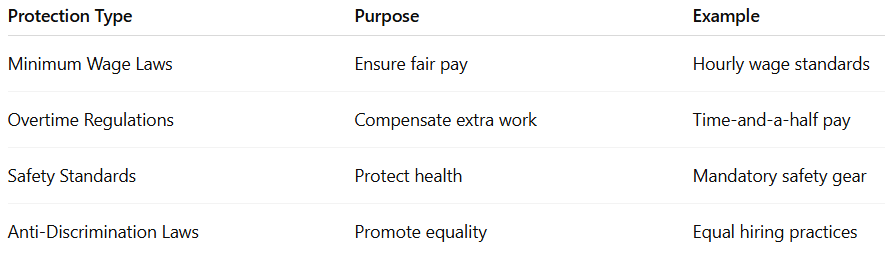
Understanding these laws is like having a map—you know where the boundaries are and when they’ve been crossed.
Employee Rights Under the Law
Knowing that laws exist is one thing, but understanding your specific rights as an employee is what truly makes a difference. These rights are your safety net, designed to protect you from unfair treatment and give you options when things go wrong.
At a basic level, you have the right to be paid fairly and on time. You also have the right to a safe working environment, free from unnecessary risks. These aren’t privileges—they’re legal guarantees in many parts of the world.
You also have the right to speak up. Whether it’s reporting unsafe conditions, discrimination, or wage issues, you should be able to do so without fear of retaliation. Whistleblower protections exist specifically to safeguard this right, although their effectiveness can vary.
Another important right is access to information. Employers are often required to provide clear details about wages, hours, and workplace policies. If those details are hidden or unclear, it can be a sign of deeper issues.
Think of these rights as tools. They’re only useful if you know how to use them. Staying informed, asking questions, and keeping records can help you protect yourself and navigate challenges more effectively.
How to Report Workers Rights Violations
Internal Reporting Procedures
When you first realize you might be facing workers rights violations, the instinct might be to either ignore it or jump straight to legal action. But in many cases, the first step actually starts inside your own workplace. Internal reporting procedures are designed—at least in theory—to address problems before they escalate into larger legal disputes.
Most companies have some form of reporting structure, whether it’s a direct supervisor, a human resources (HR) department, or an anonymous reporting system. The idea is to give employees a channel to raise concerns safely. But here’s the reality: not all systems are equally effective. Some workplaces genuinely investigate complaints and take corrective action, while others may downplay or even ignore them.
So how do you approach this step smartly? Start by documenting everything. Keep records of incidents, dates, times, and any communication related to the issue. Think of it like building a timeline—you want a clear, factual account of what happened. This not only strengthens your case but also helps prevent misunderstandings.
When reporting, clarity matters. Stick to facts rather than emotions. Instead of saying, “This feels unfair,” explain exactly what happened and why it may violate workplace policies or labor laws. This approach makes it harder for your concerns to be dismissed.
There’s also the question of trust. If you believe your manager is part of the problem, going directly to them might not be the best move. In such cases, HR or anonymous reporting tools can offer a safer route. However, it’s important to remember that HR ultimately represents the company’s interests, which can sometimes create conflicts.
Internal reporting isn’t always a perfect solution, but it can be a starting point. In some cases, issues are resolved quickly once they’re brought to light. In others, it becomes clear that further action is needed. Either way, taking that first step puts you back in control of the situation.
Filing Complaints with Authorities
If internal efforts don’t resolve the issue—or if the violation is serious enough—you may need to take things a step further by filing a complaint with external authorities. This is where workers rights violations move from an internal matter to a legal one.
Government agencies and labor boards exist specifically to handle these situations. Depending on where you are, this could include departments of labor, equal employment opportunity commissions, or workplace safety authorities. These organizations have the power to investigate complaints, enforce laws, and, in some cases, impose penalties on employers.
Filing a complaint might sound intimidating, but it’s often more straightforward than people expect. Most agencies provide online forms, hotlines, or local offices where you can submit your case. The key is preparation. Remember that documentation you gathered earlier? This is where it becomes invaluable.
Timing also matters. Many labor laws have deadlines—known as statutes of limitations—for filing complaints. Waiting too long can limit your options, so it’s important to act promptly once you recognize a violation.
One concern many workers have is retaliation. It’s a valid fear, but there are legal protections in place to address it. If an employer punishes you for filing a complaint, that action itself becomes another violation, often strengthening your case.
Seeking legal advice can also be helpful, especially in complex situations. Employment lawyers can guide you through the process, help you understand your rights, and represent you if necessary.
Taking this step can feel like a big leap, but it’s also a powerful one. It shifts the balance, bringing in authorities who can hold employers accountable and, in some cases, create change that benefits not just you, but others in similar situations.
Preventing Workers Rights Violations
Employer Responsibilities
Preventing workers rights violations isn’t just about reacting when something goes wrong—it starts with proactive responsibility from employers. A workplace that prioritizes fairness, transparency, and safety is far less likely to encounter serious issues in the first place.
Employers set the tone. If leadership values ethical behavior and enforces clear policies, that mindset tends to ripple throughout the organization. It’s like setting the rules of a game—when everyone understands them and sees them being applied consistently, there’s less room for confusion or exploitation.
One of the most important responsibilities is compliance with labor laws. This includes paying fair wages, maintaining safe working conditions, and ensuring equal treatment for all employees. But compliance shouldn’t be seen as a minimum requirement—it should be the baseline for building a positive work environment.
Training also plays a huge role. Employees and managers alike need to understand workplace policies, including those related to harassment, discrimination, and safety. Without proper training, even well-intentioned individuals can contribute to harmful situations simply because they don’t know better.
Transparency is another key factor. Clear communication about expectations, compensation, and workplace policies helps prevent misunderstandings. When employees know what to expect and feel informed, trust naturally increases.
Accountability ties everything together. Employers must be willing to investigate complaints thoroughly and take appropriate action when violations occur. Ignoring issues or protecting problematic behavior only allows it to grow.
Ultimately, prevention isn’t just about avoiding legal trouble—it’s about creating a workplace where people actually want to be. And when that happens, everyone benefits.
Employee Awareness and Advocacy
While employers carry significant responsibility, employees also play a crucial role in preventing workers rights violations. Awareness is your first line of defense. If you don’t know your rights, it becomes much harder to recognize when they’re being violated.
Think of it like navigating a city. If you don’t know the rules of the road, you’re more likely to take a wrong turn—or get taken advantage of. The same applies in the workplace. Understanding wage laws, safety standards, and anti-discrimination protections gives you a clearer sense of what’s acceptable and what’s not.
Advocacy takes that awareness a step further. Speaking up—whether for yourself or others—can feel uncomfortable, but it’s often necessary for change. This doesn’t always mean filing formal complaints. Sometimes, it’s as simple as asking questions, seeking clarification, or supporting colleagues who are facing similar issues.
Collective action can be especially powerful. When employees come together—through unions, worker groups, or even informal networks—they create a stronger voice. It’s much harder for employers to ignore concerns when they’re coming from multiple people rather than individuals.
There’s also a ripple effect to consider. When one person challenges unfair practices, it can encourage others to do the same. Over time, this shifts workplace culture, making violations less likely to occur.
Being proactive doesn’t mean being confrontational—it means being informed, observant, and willing to take action when necessary. It’s about recognizing that your voice has value and that protecting your rights contributes to a healthier workplace for everyone.
The Future of Workers Rights
Trends in Labor Rights Movements
The conversation around workers rights violations is evolving rapidly, shaped by technology, globalization, and shifting societal expectations. What was considered acceptable a decade ago may no longer hold up today, and that shift is driving new labor movements around the world.
One major trend is the rise of the gig economy. Platforms offering flexible work opportunities have created new challenges for labor rights, particularly around classification. Are gig workers employees or independent contractors? This question has sparked legal debates and policy changes in multiple countries, highlighting the need for updated protections.
Remote work is another game-changer. While it offers flexibility, it also blurs the boundaries between personal and professional life. Issues like unpaid overtime, digital surveillance, and burnout are becoming more prominent, raising new questions about how workers rights apply in virtual environments.
There’s also a growing emphasis on transparency and corporate accountability. Consumers are increasingly interested in how companies treat their employees, and social media has made it easier to expose violations. This public pressure can be a powerful force, pushing organizations to adopt fairer practices.
Younger generations are also reshaping the landscape. They tend to prioritize work-life balance, inclusivity, and ethical business practices, which influences how companies operate. Employers who fail to adapt may struggle to attract and retain talent.
Technology, while part of the challenge, is also part of the solution. Tools for tracking work hours, reporting violations, and connecting workers globally are making it easier to identify and address issues.
The future of workers rights isn’t fixed—it’s being actively shaped by these trends. And while challenges remain, the increased awareness and advocacy suggest a shift toward more equitable workplaces.
Conclusion
Workers rights violations aren’t just isolated incidents—they’re part of a broader pattern that affects individuals, businesses, and entire economies. From wage theft and unsafe conditions to discrimination and wrongful termination, these issues can take many forms, some obvious and others quietly embedded in workplace culture.
Understanding your rights is the foundation for addressing these challenges. When you know what fair treatment looks like, it becomes much easier to recognize when something isn’t right. Pair that awareness with documentation, advocacy, and the willingness to take action, and you create a powerful defense against exploitation.
Employers, employees, and institutions all have roles to play in preventing violations. It’s a shared responsibility that requires transparency, accountability, and continuous effort. And as the world of work continues to evolve, so too must the systems that protect those who keep it running.
FAQs
1. What is the most common workers rights violation?
The most common violation is wage theft, including unpaid overtime and failure to meet minimum wage requirements. It often goes unnoticed because it can be subtle and spread out over time.
2. How can I prove my rights are being violated?
Documentation is key. Keep records of hours worked, pay stubs, emails, and any incidents. This evidence strengthens your case when reporting or filing a complaint.
3. Can I be fired for reporting a violation?
No, in many jurisdictions, retaliation for reporting violations is illegal. If it happens, it can become an additional legal claim against the employer.
4. What should I do if HR ignores my complaint?
If internal reporting doesn’t work, you can escalate the issue by filing a complaint with government labor agencies or seeking legal advice.
5. Are gig workers protected under labor laws?
It depends on the country and classification, but many regions are updating laws to extend protections to gig workers due to growing concerns about exploitation.
SOURCEs
https://www.ilo.org/global/lang--en/index.htm
https://www.ilo.org/global/topics/safety-and-health-at-work/lang--en/index.htm
https://www.ohchr.org/en/business-and-human-rights
https://www.dol.gov/agencies/whd
https://www.epi.org/publication/employers-steal-billions-from-workers-paychecks-each-year/